Étale Things and Living Graphs
How do mathematician even come up with names? And what is the little animation below anyway?
How do anyone name “new things”? It’s part of the discovery process to associate a name to the discovery. The marketing of Science in a way.
My first crush in mathematics was imaginary numbers.
I clearly remember being told as a young high schooler about how when I’ll grow up I will learn about those mysterious numbers.
I just learn that squares were positives, until they weren’t anymore. But I couldn’t simply wait to be in the right class, so I went to my high school library and check out the Terminale’s textbook1 (Terminal is the last year of highschool in France).
Some people fall in love with mathematics out of a thirst for knowledge, or a desire to understand patterns. I was attracted by names. Imaginary numbers sounded forbidden, slightly illicit—mathematics smuggling fiction into rigor.
My second crush came much later and it was étale cohomology.
Slightly before starting my PhD, I learnt about derived and triangulated categories and went straight to the source, S.G.A 4½.
Contrary to the other episodes of the Séminaire de Géometrie Algébrique du Bois-Marie, this one was not a seminar. It is a compilation of Pierre Deligne’s notes on some notions and results that sits in between SGA 4 and SGA 5.
The name étale also used literally in english struck me. What object could be étale, and why not the less poetic and more practical étalé?
It evokes smoothness, lightness, something that spreads without tearing. It feels more like a landscape than a construction. According to J. S. Milne:
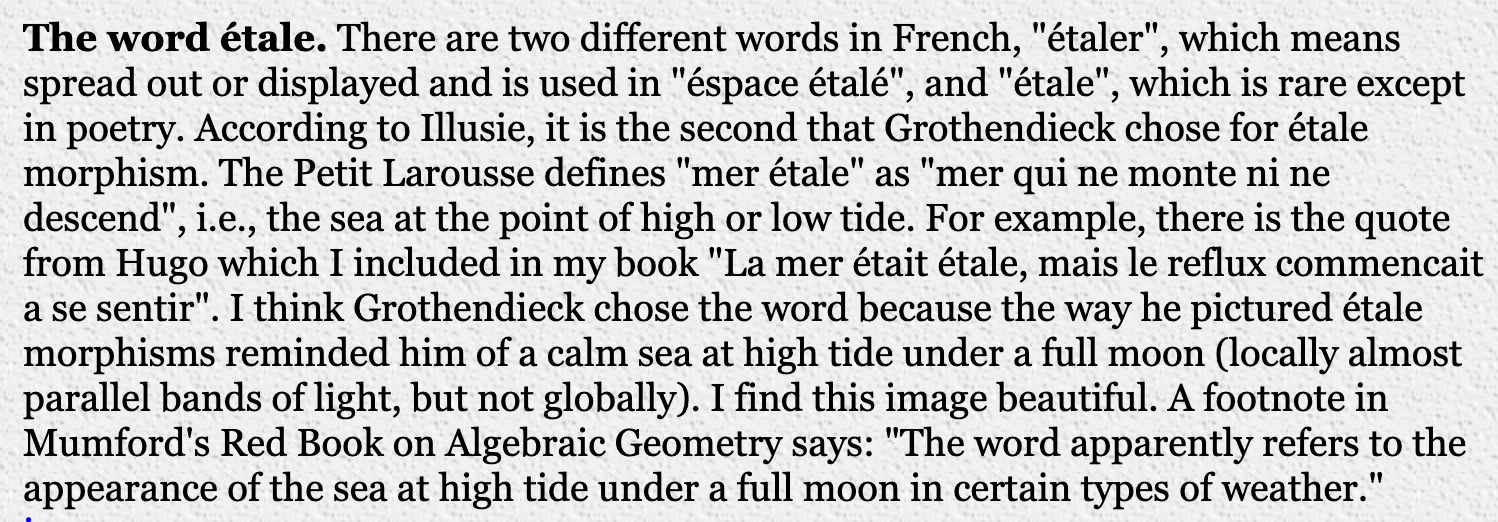
“Grothendieck chose the word étale because the way he pictured étale morphisms reminded him of a calm sea at high tide under a full moon.”
The only other occurences (that I am aware of) of a French word that is kept as is in the mathematical vocabulary are martingale and gerbe… if you know more please reach out.
So what is this animated graph ?
It is a visualization of all the artefacts in SGA 4½ (lemmas, propositions, theorems, corollaries,…) and their logical dependencies. Each node is a statement; each edge records “this is used to prove that.” Thanks to this beautiful collection of tex files, a simple regex-based heuristic can extract all artifacts. The logical dependencies are inferred by an LLM. In a following post, I’ll explain how this was designed…
In the mean time, you can explore this SGA graph here
Did I tell you that “Mal nommer les choses…”2 ?
-
See the last paragraph of this earlier post… ↩